

Celia Doherty
Product Marketing Manager
From a Pub to a Four-Million-Pound Plant
How a school-gate conversation became one of Scotland's most ambitious renewable energy businesses, and what a generator can build when it stops losing revenue before it's paid.
Fifteen years ago, Garth Way was welding pieces of metal together in his garage.
He'd bought components off the internet, taught himself to weld, and was attempting to build a gasification system, a machine that converts wood into electricity and heat. He wasn't an energy professional. He just didn't want to keep paying for power he could make himself.
A few miles away, Duncan Paterson was working on the same idea. They didn't know each other.
They met because of a school run.
"My brother-in-law said, there's a weird guy I keep speaking to when I drop my kids off at school called Duncan. He mentioned the word gasification, and you're the only other person that's ever mentioned that weird word to me. I don't even know what it means, but maybe you should meet him."
That conversation ended up in a pub. Biosus Energy started there.
What the market was taking
When a generator exports power, payment doesn't arrive cleanly. It passes through a chain: an aggregator, a utility's trading team, an external trading desk. Each layer takes a cut before the money reaches the generator that actually made the electricity. Add imbalance charges on top, and up to 10% of the power's value can disappear before the generator sees it.
That chain is forty years old. It was never designed for the kinds of businesses building renewable assets today.
For Garth and Duncan, the logic was simple. Someone offered them more per unit of electricity. They took it.
"Do you want a better deal? Yes please. Everyone accepts that logic," Garth says.
A Frankenstein machine that's still running
The two men pooled their parts, some sourced from India, some bought in the UK, some designed themselves, and built something that worked. A German company came on board. Someone saw it and asked for a bigger one.
"It takes wood, makes electric and hot water," Garth says. "It's like our Frankenstein baby that me and Duncan had together. And it's been running for the last eleven years."
From one machine built in a garage, Biosus now manages a portfolio of generating assets across Scotland: biomass units, natural gas and biogas systems, solar installations. The goal was always the same: generate power from renewable sources and help commercial customers reduce their costs in the process.
Today, Ecogenesis forms part of Biosus Energy Holdings, a renewable energy group made up of specialist businesses across the clean energy sector. Alongside Ecogenesis sits Biosus Energy, the group's engineering and project delivery arm, which designs and installs commercial solar PV, battery storage, heat pumps and integrated on-site energy systems for businesses throughout the UK.
The economics of staying in the game
A higher export rate per unit of electricity is not just this month's income. It compounds.
Switching to tem changed the number. On a smaller site, £6,000 a year more. On a larger one, £30,000. Across a portfolio, over a decade, that is new employees, new sites, new kit, and the headroom to keep building.
The margin doesn't stay inside Biosus.
A community centre nearby was overpaying on its energy bills. Garth made one phone call and saved them £10,000 over five years. Biosus helped a local sawmill set up with biomass equipment. The sawmill used it to dry timber. Garth bought that timber back to build the shed he works from every day.
"We try to buy back from our own people," he says.
This is what a higher export rate does. It doesn't stop at the business. It moves.
A visit no one else had made
Before the Ecogenesis open day, Duncan texted Jason Stocks, tem's co-founder. He said they were probably too small to bother with.
Jason came anyway.
Duncan told Garth that in all their years generating power, no one from any energy company had ever done that. Not shown up in person, not taken the time to understand what the site was actually doing.
"If you need someone they come and help you and they don't hassle you when you don't need them," Garth says. "It's like any good friend. You can call them if you need them."
The open day
About forty people came to the Ecogenesis site. Customers, community stakeholders, neighbours.
By then, what they'd built was plain to see. A four-million-pound biomass CHP facility, a Combined Heat and Power plant that generates electricity and captures the heat that would otherwise be wasted. A pipeline of projects taking shape around it: supplying power to nearby businesses, wood chip sales, heat-led site development. The kind of thing that only makes sense when the revenue floor is high enough to support it.
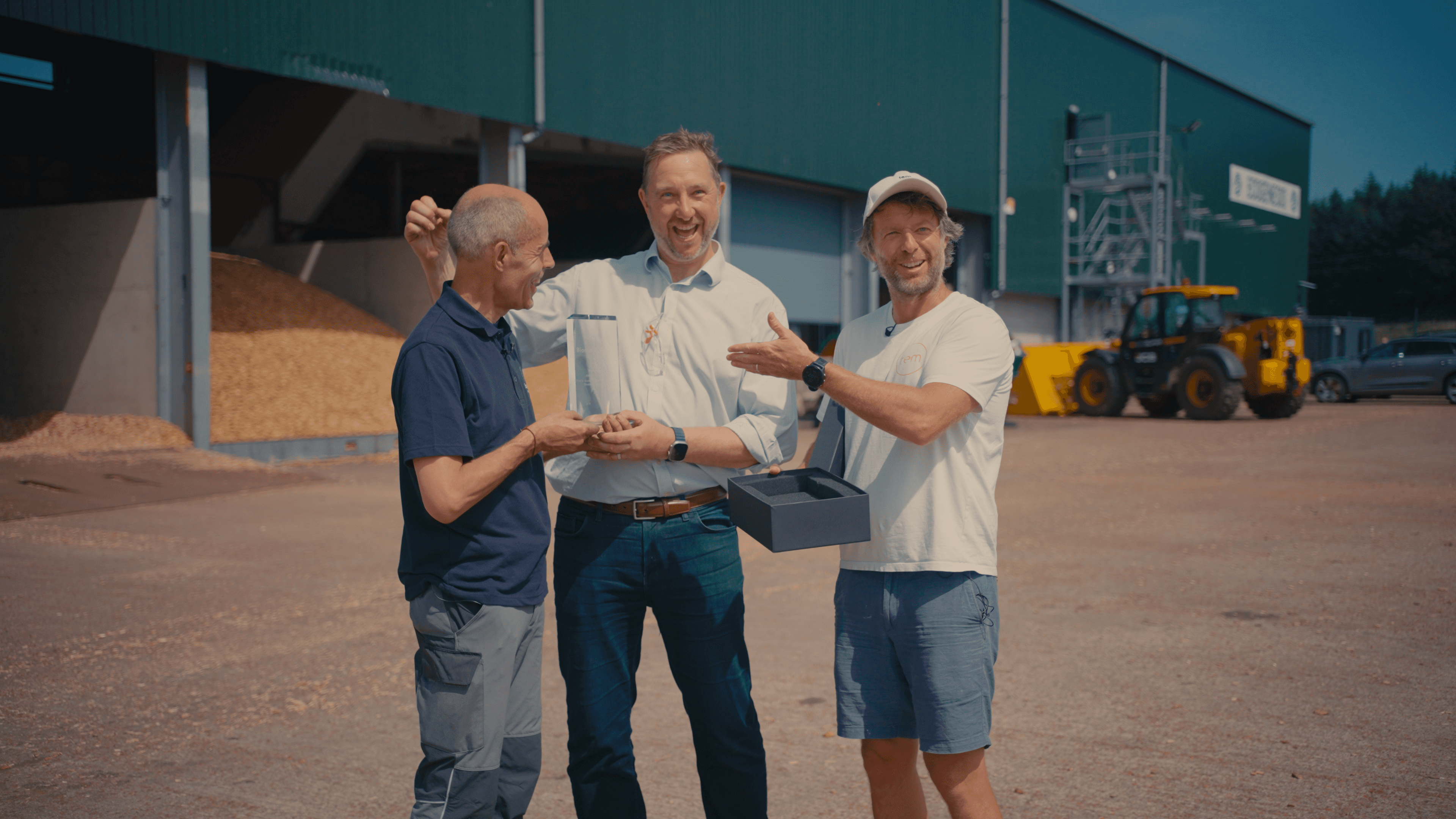
Duncan mentioned that the ROC accreditation was one of the things he was most proud of. In 2014, Balring Energy had been the first in Scotland to receive a double Renewables Obligation Certificate for a biomass unit, a government-backed subsidy awarding credits per unit of electricity produced. They'd never marked the occasion properly.
Jason arrived with a trophy. Garth looked at it, pumped his fist, and laughed.
"Check us out. How brilliant. I thought it might have just been a big rock."
Garth's counter-presentation: two packs of frozen sausages, retrieved from somewhere on site.
"We all tend to be heads down, bottoms up, squirrelling away at what's in front of you," Garth says. "You've got to take a little bit of time to celebrate the wins."
Fifteen years from a school gate conversation and a garage experiment, that seems about right.


